Why Experiments Fail When Customer Data Is Out of Sync
Teams run experiments to learn. Change a flow, test a message, tweak onboarding, measure the impact.
But many experiments fail to produce clear answers. Results look noisy. Metrics contradict each other. The team debates whether the experiment worked at all.
In a surprising number of cases, the root cause is customer data that is not aligned.
Experiments assume a shared view of the customer
For an experiment to work, every system involved needs to agree on who the customer is and what state they are in. Analytics needs to know which variant a user saw. Marketing needs to know when that user converted. The CRM needs to reflect the outcome.
When those systems are out of sync, attribution breaks down. Conversions appear without causes. Users fall into the wrong cohorts. Events arrive too late or get associated with the wrong profile.
At that point, the experiment is no longer measuring reality.
How data inconsistency distorts results
These issues are subtle. An experiment might look directionally correct but fail significance checks. Or it might appear to work in analytics but not in revenue reports. Teams start questioning sample size, seasonality, or random noise.
Meanwhile, the real issue is that different tools are telling different stories about the same customers.
This leads to slower iteration. Teams rerun tests. Confidence drops. Eventually, experimentation itself feels unreliable.
Sync as a prerequisite for learning
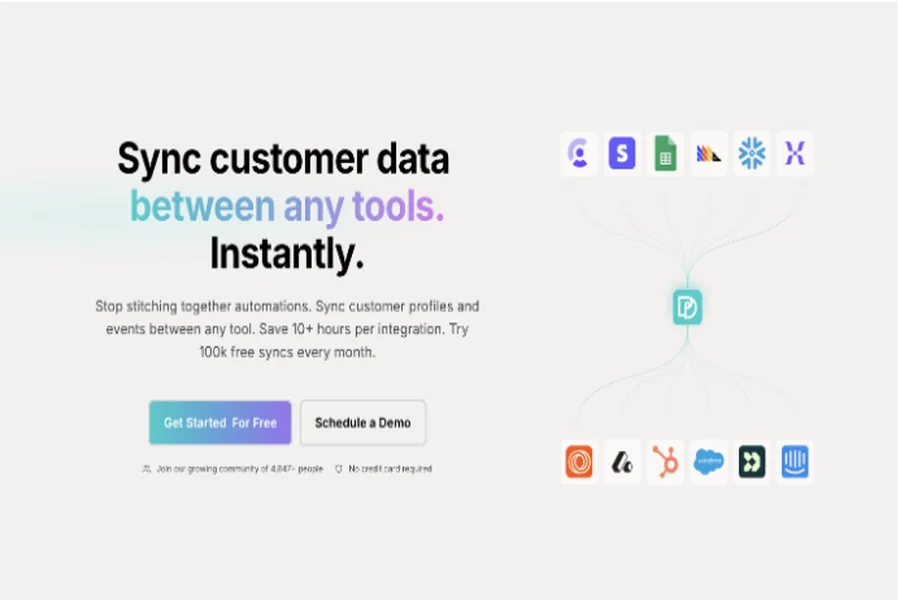
Oneprofile approaches customer data from the perspective of alignment rather than storage.
It keeps customer profiles and events synchronized across analytics, CRMs, marketing tools, and support systems in real time. When a customer takes an action, every connected system sees the same update.
This consistency ensures that experiments are measured against a shared reality. Metrics line up. Attribution makes sense. Teams can trust the results and move forward.
Built to support real workflows
Oneprofile is designed to fit into existing stacks without forcing teams into a new interface or data model. Sync happens behind the scenes, continuously.
You can start with 100,000 syncs per month for free, which is enough to support real experiments and real traffic. Pricing scales based on usage and is clearly outlined on the pricing page.
Better data leads to better decisions
Experiments are only as good as the data behind them. When customer data stays aligned, teams spend less time arguing about numbers and more time acting on insights.
If you want your experiments to reflect what is actually happening with your customers, you can get started with Oneprofile at https://us.getoneprofile.com/register
Clear data makes learning faster, and faster learning compounds.